

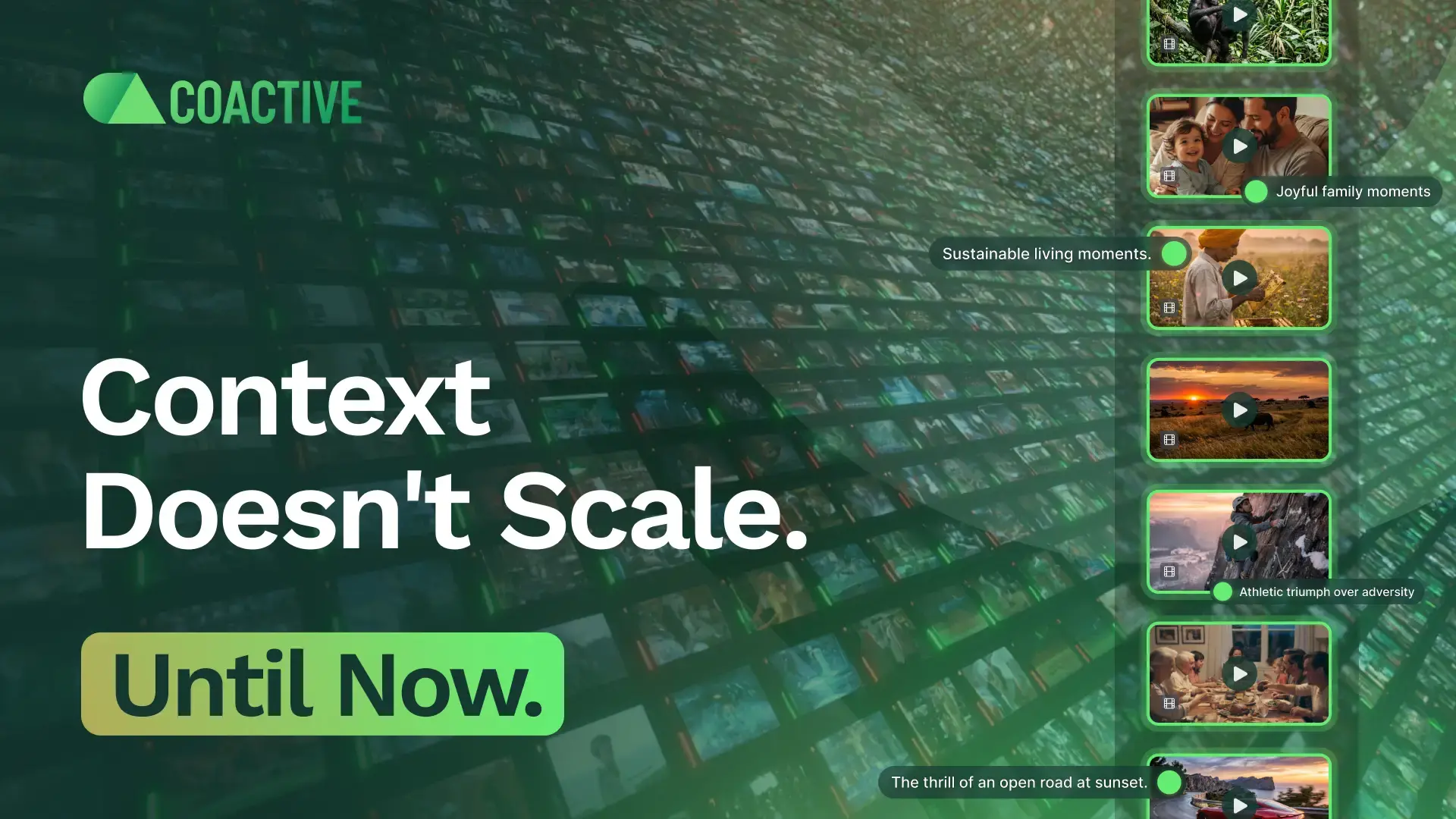
Context Doesn't Scale. Until Now.
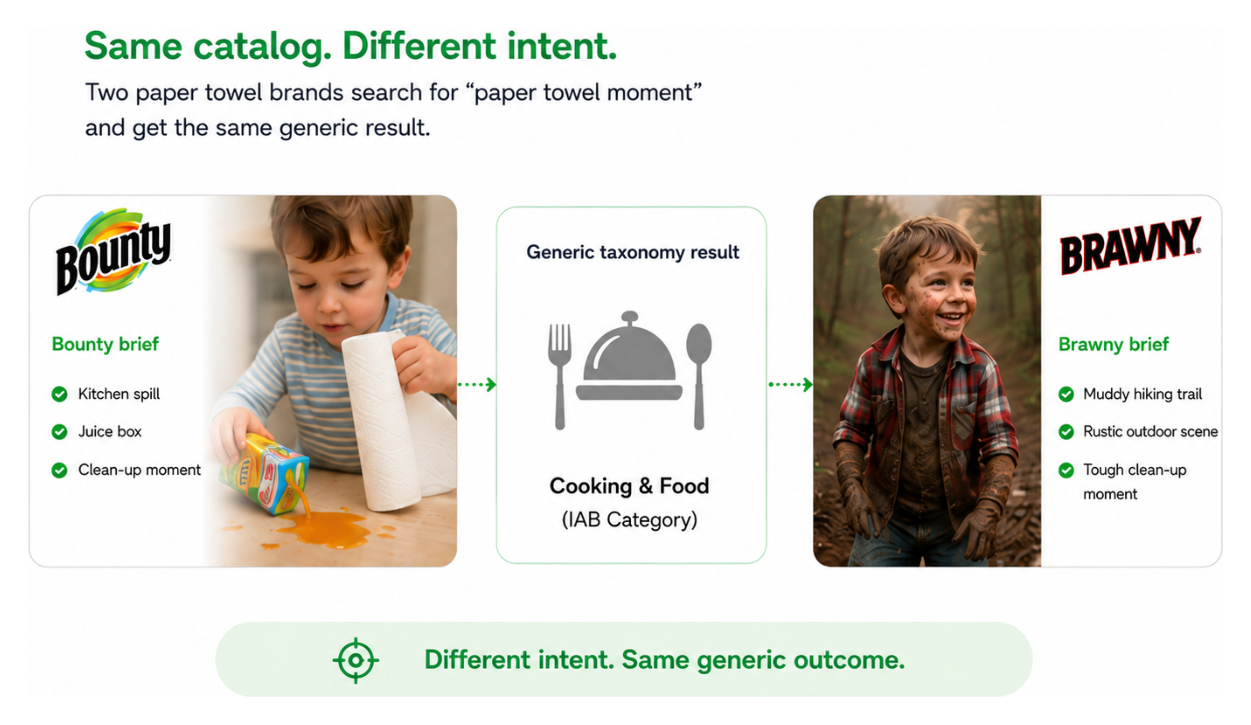
Two paper towel brands walk into the same content catalog looking for their moment.
Bounty wants kitchen spills. A toddler knocking over a juice box. Something that says “quicker picker upper.” Brawny wants a muddy kid on a hiking trail, a rustic scene that matches its brand DNA. Both brands type variations of “paper towel moment” into the same system. Both get back the same thing: cooking and food.
This is contextual advertising in 2026. The targeting strategy that everyone agrees should work, and that nobody has been able to make work at scale.
Everyone agrees. Nobody can prove it.
For five years, I have heard the same thing from every side of the transaction. Publishers say it. Agencies say it. Brands say it with the most conviction: context doesn’t scale.
They were not wrong.
The problem was never whether context matters. We have always known that placement shapes perception. A hospital ad next to a story about heart failure can be powerful or grotesque depending on the brand behind it. Context matters. That has never been the debate.
The debate is about proof. About doing it at scale. About the fact that advertisers and publishers have never spoken the same language about what a “moment” actually means.
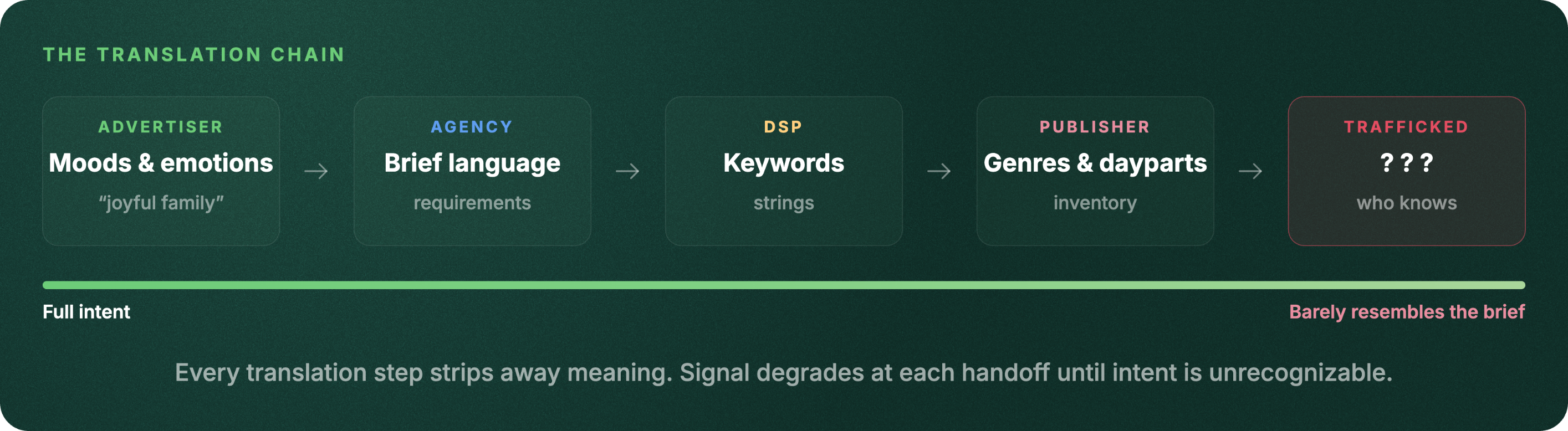
Here is what happens today: an advertiser sends a brief asking for “joyful family moments, aspirational but relatable.” A publisher responds with what their systems can deliver: show titles, genres, dayparts, IAB category codes. The brief described a feeling. The response described a spreadsheet.
And this translation happens at every layer of the ecosystem. Advertisers speak in moods. Agencies convert moods into briefs. DSPs convert briefs into keywords. Publishers map keywords to genres. By the time a campaign gets trafficked, the original intent has been through so many translations that nobody can say with confidence whether the ad actually ran against the moment the brand wanted.
That gap between what advertisers ask for and what publishers can package is where value goes to die.
AI gives you the map. It doesn’t give you the destination.
Multimodal AI changed the underlying math. For the first time, it is possible to analyze video content at the moment level, across entire catalogs, in a single pass. The technology maps every shot along hundreds of dimensions: themes, tone, visual composition, emotional register, on-screen actions.
Think of it as a multidimensional graph where every piece of content gets plotted. Joyful family dinner lands in one region. High-energy sports in another. Luxury travel somewhere else. AI can build this map across millions of minutes of content. That part works now.
But here is what most people get wrong about AI and content: the map is not the destination.
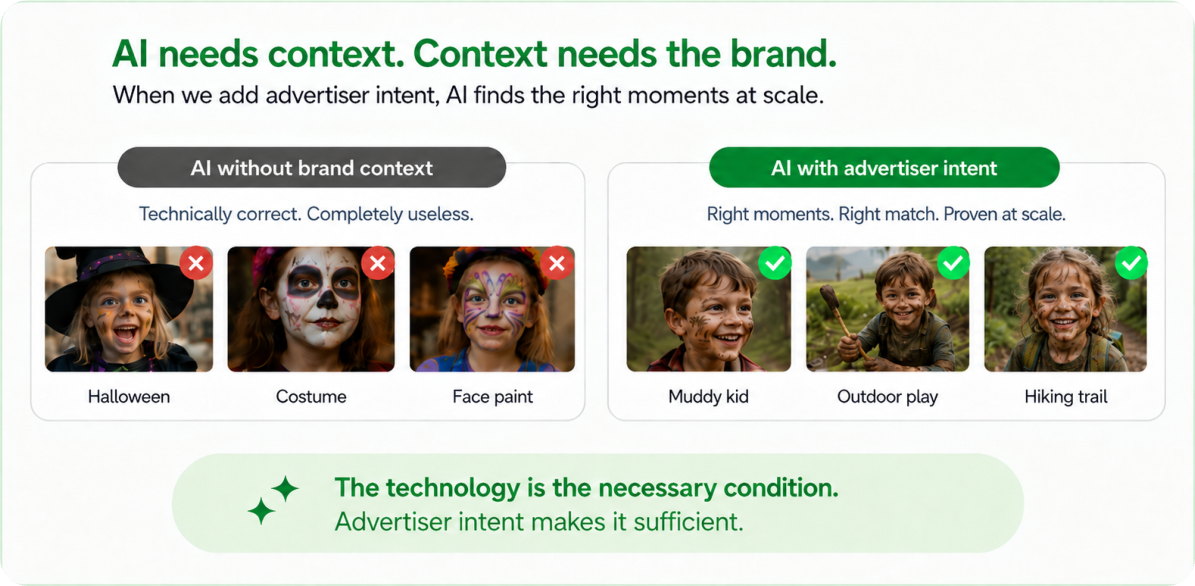
We learned this firsthand. When we prompted an AI model to find “dirty face” moments for a paper towel brand, it returned Halloween costumes and face paint. Technically correct. Completely useless for the brief. The model did not understand that “dirty face” in the context of Brawny means a kid who fell in the mud on a hike, not a zombie at a costume party.
AI without advertiser intent introduces bias. It finds patterns, but it cannot know which patterns matter to your brand unless you tell it. The human in the loop is not a nice-to-have. It is the entire mechanism that makes contextual targeting actually contextual.
When we added the advertiser’s context, visual examples of what “dirty face” actually means for this brand, the model immediately recalibrated. It found the right moments. And it could find them across every piece of content in a catalog, at a scale no human team could match.
The technology was the necessary condition. Using it to capture the advertiser’s intent made it sufficient. Without a shared contextual intelligence layer, the industry defaults to its blunt instrument: avoidance. Advertisers block entire content categories like news and UGC, not because the inventory is unsuitable, but because they have no way to prove which moments are. Publishers lose revenue on their most differentiated content. Advertisers miss audiences they actually want to reach.
Advertisers want to own moments that reinforce their brands. Publishers want to monetize those moments across their content libraries. The problem is that neither side has ever had a shared way to define them.
This is why we built Context Studio.
Introducing Context Studio
This is why we built Context Studio: the first platform where advertisers and publishers plan, validate, and activate campaigns from the same definition of a moment.
The shift is fundamental. Instead of publishers defining inventory through pre-built categories and hoping it maps to what the advertiser meant, the advertiser’s brief becomes the targeting signal.
Include family dinner scenes but exclude alcohol. Target graduation moments while filtering out smoking. Find eco-friendly content that aligns with sustainability, without anything that reads as greenwashing. The specificity of the brief is the specificity of the targeting.
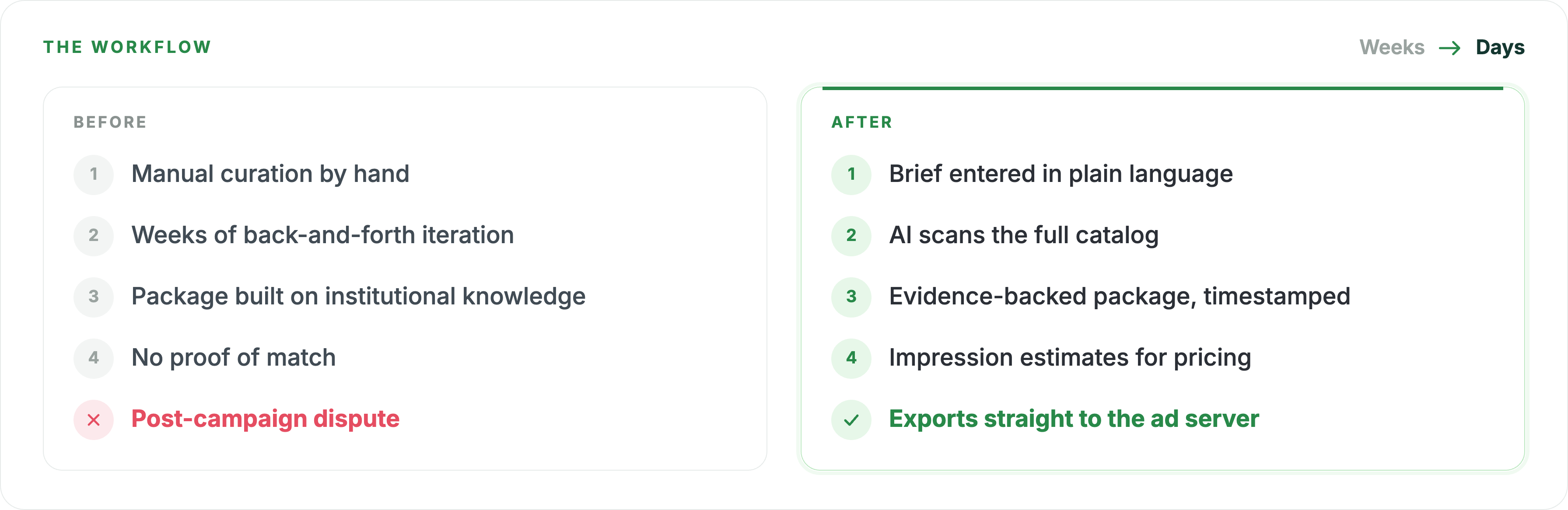
Context Studio sits upstream of existing activation infrastructure. It is the layer where the most consequential decisions in a contextual buy actually happen: translating the brief into targeting criteria, finding the right inventory across a publisher’s full catalog, generating impression estimates, and proving the match with moment-level evidence. Packages export directly to FreeWheel and Google Ad Manager with no reformatting or manual handoff.
Every package comes with proof. Timestamps for qualifying moments. What was excluded and why. Impression estimates for confident pricing. Response times compress from weeks to days. And the long tail of a publisher’s catalog, often their most differentiated content, becomes discoverable and sellable for the first time.
Proven at scale
NBCUniversal was the first to put this into production. A luxury advertiser came in with a narrow brief around environmental sustainability. The kind of request that would normally take weeks of manual curation and still leave everyone uncertain about the match.
The NBCU team used Coactive to translate that brief into a precise, moment-level contextual package and activated it on Peacock. The advertiser, the publisher, and the campaign team all worked from the same shared definition of what “sustainability” meant in this content, for this brand, in this campaign.
The campaign delivered 7x more website traffic, 56% higher search engagement than competitive streaming platforms, and a 38% lift in audience perception of the brand as environmentally conscious.
Ryan McConville, Chief Product Officer and EVP of Ad Products and Solutions at NBCUniversal, describes the shift:
“Context Studio represents the next step, putting that contextual power directly in the hands of our sales and activation teams so that we can respond faster, package more precisely, and unlock even greater value for our advertising partners.”
Those results came from one structural change: everyone worked from the same contextual truth.
What this means for each side of the table
For publishers: Your content library becomes a targetable asset defined on each advertiser’s terms. Respond to complex briefs in days instead of weeks. Unlock sellable inventory in the long tail of your catalog that manual curation has never reached. Price with confidence because every package comes with moment-level proof.
For brands: Define, validate, and measure the exact moments you want your brand to own. Build campaigns around specific emotional, cultural, and behavioral contexts rather than accepting generic categories as a proxy for intent. See the evidence before you buy. Verify the match after the campaign runs.
For agencies: Gain a consistent, auditable framework that works across publisher partners. Spend less time translating briefs into inventory packages and more time optimizing campaigns and advising clients. Justify premium contextual CPMs with evidence your clients can see.
Get started
Context Studio is available now to enterprise publishers and MVPDs. Publishers can be operational on their existing catalog within weeks, with no disruption to downstream activation workflows.
If you sell against a content catalog measured in millions of minutes, we would like to show you Context Studio running on your own content. Request a demo →
Brands and agencies interested in transparent, intent-driven contextual planning from the buy side can reach out directly. We will walk you through the evidence layer and show you how packages get built.
Thank you to Satya and our engineering and product teams for building Context Studio from research prototype to enterprise product. And to our partners at NBCUniversal for pushing the standard of what contextual advertising can deliver.
For five years, I have been told context doesn’t scale. We just proved it does.
— Cody